Silom, Sathorn & the Lumphini edge: Bangkok's original business district, still the money postcode
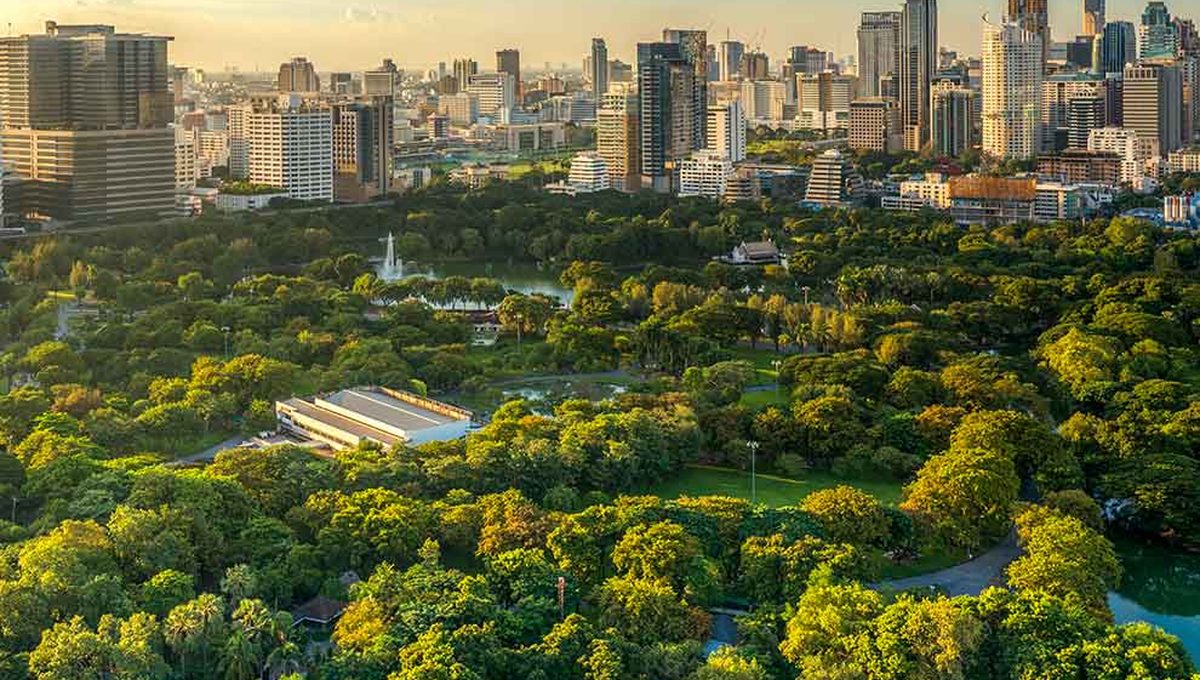
Embassies, bank towers, a 360 rai park and the river, with One Bangkok and Dusit Central Park adding new weight. You pay the most, and you get the most certainty.
What it is
The original central business district: Silom and Sathorn roads running parallel from Lumphini Park to the Chao Phraya, carrying the banks, the law firms and the embassies.
Where it sits
Dead centre. BTS Silom line through the middle, MRT Blue Line at Si Lom and Lumphini, Siam ~7 minutes, the river piers ~5, Suvarnabhumi ~40 by car.
The numbers
Prime CBD stock runs roughly 200,000-350,000 THB per sqm. New 1-beds from ~8M THB. Gross ~3.5-5%, the prime floor; net 1-1.5 pts lower.
The life
A 360 rai park at the head of the district, river boats at the foot, Bib Gourmand som tam at lunch, Little Tokyo and serious cocktail rooms after work.
The catches
Among the highest capital values in the city, yields at the prime floor, and the office blocks go quiet at weekends. The certainty is real and it is fully priced.
The play
Buy certainty: liquidity, blue-chip tenants, walk-to-work demand. The unusual part is the kicker: One Bangkok and Dusit Central Park are committed capital already opening next door.
So where is this, actually?
The shaded patch is the district this guide covers: the grid between Lumphini Park and the Chao Phraya, held by Silom and Sathorn roads. Hover or tap any station for the train time from Chong Nonsi.
Three things the map makes obvious. Two rail lines lattice this district rather than one: the BTS Silom line runs through the middle of it and the MRT Blue Line wraps the Lumphini edge, crossing at the Sala Daeng and Si Lom interchange, so the whole city is reachable without a car. Lumphini Park sits at the head of the district, 360 rai of it, with One Bangkok plugged into the park's southeast corner. And the district ends in water: Saphan Taksin station feeds the Chao Phraya piers, which is a commute for some residents and a weekend amenity for the rest.
How to read a Bangkok address
Every Bangkok area fits one of three buckets, and knowing which one you are looking at does most of the work.
1. Prime is the proven core: Thonglor, Phrom Phong, and this district. You pay the most and you get certainty: a liquid resale market, tenants who always come, steady low-single-digit appreciation. The growth that made these areas famous already happened, which is exactly why they cost what they do. This guide is about a prime district, the original one.
2. Value areas sit close to the core without the same headline growth ahead of them: Wutthakat and Talat Phlu across the river are the textbook case, one seat into these offices at a fraction of the entry price. You get proximity and income; you give up the catalyst.
3. Growth corridors are the middle: real demand today with the city's capital still visibly arriving, like Punnawithi and Bang Na on the east side. More upside, more timing risk.
Prime is usually the bucket where the story is finished. Silom-Sathorn is the interesting exception right now: the district is fully proven, and two of the largest private projects in Thailand's history have just opened or are opening inside it. That does not turn prime into a growth bet, and nobody honest will promise you a re-rating. It does mean the proven core is getting new retail, new offices, new hotels and a new park deck, which is more than most prime districts anywhere ever get late in their story.
What this district is
Silom was Bangkok's financial address before the BTS existed, and Sathorn, the wider and greener of the two parallel roads, became the embassy and corporate row beside it. What holds the property market up here is not one project but a payroll: the headquarters of major Thai and international banks, the Big Four accounting firms, the top law firms, the insurers and a string of embassies, all within a walk of the same few stations. Three anchors define the district today.

The office and embassy core
Banks, law firms, the Big Four, insurers, multinational regional offices and embassies including Singapore, Germany and Australia, stacked along two parallel roads. This is the deepest concentration of high-salary employment in Thailand, and it generates walk-to-work rental demand that does not depend on tourism or trend.

One Bangkok
A roughly 120 billion baht district by TCC Assets and Frasers Property on Rama IV facing Lumphini Park, billed as Thailand's largest private-sector property development. First phase opened October 2024: two retail zones, three office towers, Ritz-Carlton and Andaz hotels. The developer reported about two-thirds of the first office phase let by mid 2026, with tenants like Baker McKenzie, EY, Microsoft and Agoda, and later phases still to come, including a planned 430 metre signature tower.

Dusit Central Park
The old Dusit Thani corner at Rama IV and Silom, rebuilt as a hotel, mall, offices and residences connected directly to the Sala Daeng and Si Lom interchange. The reborn Dusit Thani hotel opened in 2024, the retail, offices and a roof park the developer bills as Thailand's largest opened through 2025, and the residences, over 95 percent sold on developer figures, began transferring from late 2025.
That is the case in one line: the deepest employment base in the country already lives at these stations, and roughly 160 billion baht of committed private capital has just added the retail, hotels, offices and green space around it. You are not asked to imagine anything; you can walk through most of it today.
Read the trade before the brochure does it for you. This is among the most expensive residential land in Thailand, so the rent, good as it is, produces yields at the prime floor: roughly 3.5 to 5 percent gross, less after costs. The office blocks and their lunch economy go quiet at weekends, which some residents love and others find flat. And the One Bangkok and Dusit story, real as the concrete is, should be underwritten at zero: buy the district because the demand is proven, and let any re-rating from the new projects arrive as a bonus. If you want maximum yield or a doubling story, this is the wrong postcode, and the honest ones will tell you so.
The feel of the place
Two parallel roads, two different personalities, and the difference decides which building suits you.


Silom is the eclectic one: street stalls against bank lobbies, the Sri Maha Mariamman Hindu temple trailing marigold garlands down Pan Road, Thaniya's Japanese izakaya strip, and one soi of Patpong's old neon. Sathorn, a block south, is the formal one: embassy lawns, hotel driveways, plane trees and the quiet residential sois behind them, Suan Phlu and Yen Akat, where the long-stay expats actually live. Chong Nonsi is the hinge between the two, a skywalk crossroads under MahaNakhon's pixelated silhouette. Past Surasak the district relaxes into Bang Rak's shophouse grid and ends at the river. The crowd is the most international in Bangkok on a weekday: bankers and paralegals at lunch, embassy staff, nurses from three hospitals, monks, flower sellers, and a steady stream of Lumphini runners at both ends of the day.
Where you'll actually eat

The lunch economy here is a genre of its own: thousands of office workers pour into the sois every weekday, and the food rose to meet them. Somtum Der, the Isan kitchen born on Soi Sala Daeng, holds a Michelin Bib Gourmand and has exported branches to New York, Tokyo and Taipei; the original is still a lunch queue. Convent Road runs a full street-cart economy on weekdays, Thaniya is a working Little Tokyo of sushi and yakitori, and the Michelin Guide keeps a dedicated after-work list just for Si Lom and Sathon. The upper end is equally served: hotel dining rooms along Sathorn and a scatter of destination restaurants in the converted houses off Convent and Sala Daeng.
Coffee, between the towers

Every office podium carries the franchise tier, so the interesting scene lives in the side streets. Luka, the brunch-and-coffee room inside the Casa Pagoda furniture store on Pan Road, is the neighbourhood's fixture, and the shophouse blocks toward the river around Surasak and Bang Rak have quietly filled with independent roasters and bakeries as inner-Sukhumvit rents push operators west. It is a workday scene more than a laptop-nomad scene: full at 8 am and 1 pm, calm in between.
Malls and retail, newly serious

For years this district worked with Silom Complex above Sala Daeng station and left the destination retail to Siam. That changed fast: One Bangkok opened two retail zones in late 2024 with a third, Post 1928, in the next phase, and Central Park's mall at the Dusit corner opened through 2025 plugged straight into the interchange. Siam's mall row is still 7 minutes up the train, and ICONSIAM is a river hop from Saphan Taksin. The district went from underserved to arguably oversupplied with retail in two years, which is good news for residents if not for every retailer.
Nightlife, from cocktail rooms to one honest soi

After-work drinks are the district's native format. Vesper on Convent Road is one of the cocktail rooms that put Bangkok on Asia's bar map, the rooftops bracket the district (Vertigo on the Banyan Tree's roof over Sathorn, Sky Bar at the State Tower river end), Silom Soi 4 runs one of Asia's most established LGBTQ bar strips, and Thaniya pours whisky for the Japanese business crowd. The honest line about Patpong: the adult-nightlife strip still trades alongside a souvenir night market, it is one soi out of dozens, and it stopped defining this district years ago. Walk one block and you are back among bank towers.
Green space: the best in central Bangkok

Most Bangkok districts apologise for their parks. This one leads with them. Lumphini, 360 rai and the city's first public park (1925), sits at the head of the district: a 2.5 km running loop, swan boats, outdoor gyms, and the famous resident water monitors. The Green Bridge, an elevated 1.3 km walkway, links it to Benjakitti Park's wetlands, so a weekend run can cover two major parks without touching a road. Add One Bangkok's landscaped plazas and the new roof park at Dusit Central Park, and this is the strongest green offer of any prime district in the city.
Hospitals, schools, airports (the practical layer)
This layer is a quiet strength: the district has run international-grade institutions for over a century.

- Hospitals. Three sit inside the district itself: BNH on Convent Road, founded by the British community in 1898 and still a favourite of expats and embassy staff; Saint Louis Hospital on South Sathorn, opened the same year, with a BTS station now named after it; and Bangkok Christian Hospital on Silom Road, serving since 1949. The marquee flagships like Bumrungrad and Samitivej are a cross-town ride, but for daily and serious medicine alike, few Bangkok addresses are better covered on foot.
- Schools. St Andrews International School's Sathorn campus is a short walk from Soi Convent, which is rare: an international school inside the business district. Shrewsbury International's riverside campus is a short drive down Charoen Krung, with bus routes covering Sathorn and Silom. The heavyweight cluster of international schools sits over on Sukhumvit, so families comparing districts should weigh the specific school run, not the label.
- Airports. Suvarnabhumi is roughly 40 minutes by expressway, or BTS to Phaya Thai and the Airport Rail Link if you prefer rail. Don Mueang, the budget-airline field, is 45 to 60 minutes north. Central, but not airport-adjacent; the east-side corridors beat it on that one measure.
What locals know (and listings never mention)
- The district has a ghost station story. Saint Louis station sat in the BTS fare table from 1999 while not existing; it was finally built and opened in February 2021, 22 years late. Buildings near it went from "long walk" to "at the station" overnight, and some pricing still has not caught up.
- The weekend flip is real, and it has two faces. The office blocks and the Convent Road food carts go quiet from Friday night. Residents either love the calm (Lumphini at 7 am on a Sunday is the best version of Bangkok) or find it flat. Walk the block on both a Tuesday and a Sunday before you choose a building.
- The park has dragons. Lumphini is home to a famous population of Asian water monitors, some approaching two metres. They are harmless, they photograph like dinosaurs, and long-time residents treat them as neighbours.
- You can run two parks without crossing a road. The Green Bridge links Lumphini to Benjakitti's wetland boardwalks, roughly a 10 km loop if you circle both. Very few cities offer that from a business-district doorstep.
- There is a Hindu temple in the middle of the money. Sri Maha Mariamman on the Silom-Pan Road corner, built by Tamil immigrants in the 1870s, anchors a lane of garland and curry vendors. It is why this stretch of Silom smells of jasmine at 8 am.
- The one-way maze punishes drivers. Silom, Surawong and parts of Sathorn run one-way in rush hours, so a 900 metre trip by car can take three sides of a square. Residents ride the train and walk the skywalks; the car is for weekends.
Getting around
The district is the destination other areas measure their commute to, so most trips are short. Two lines cross here, and the river adds a third option at the foot of Sathorn.
| Where | How far |
|---|---|
| Within the district the offices, the park, the piers | Sala Daeng ~2 min by BTS from Chong Nonsi; Saphan Taksin and the river ~5; Lumphini Park on foot from the Sala Daeng end |
| Across town shopping, Sukhumvit, the old town | Siam ~7 min, one seat; Asok / Sukhumvit ~10 min via MRT from Si Lom; ICONSIAM via river boat or Gold Line from the Saphan Taksin end |
| Airports | Suvarnabhumi ~40 min by expressway (or BTS + Airport Rail Link via Phaya Thai); Don Mueang ~45-60 min by road |
Who lives here, and who rents from you
The tenant pool is the deepest and best-paid in Bangkok, and it prices accordingly. Three kinds of tenant meet here.
1. The walk-to-work professional. Finance, legal, accounting and consulting staff whose offices are inside the district. For them a Silom-Sathorn address converts commute time into life, and they pay a premium for that conversion every month. This demand survives downturns because the employers do.
2. The corporate and embassy tenant on a package. Executives and diplomats with housing allowances, often on one-to-two-year leases arranged by employers. They rent the newer and larger stock, they pay reliably, and they are the reason prime landlords experience less vacancy drama than the market average.
3. The hospital and lifestyle set. Staff and long-stay patients' families around BNH and Saint Louis, plus the residents who simply want Lumphini in the morning and the river at the weekend. Smaller than the first two pools, but steady.
What you will not get is the highest percentage yield in the city. The same certainty that fills your unit is priced into what you paid for it.
What it costs, and what it earns
First, the level. Prime central Bangkok stock runs roughly 200,000 to 350,000 THB per square metre, and district-wide averages put Sathon around 40 percent above the Bangkok median (listing-aggregator data, early 2026). You are buying the most proven square metres in the country, and the ladder below is about which vintage of them.
The interesting choice in this district is age. The 2000s generation gives you size and a lower price per square metre; the newest towers give you finish, facilities and the easiest resale story. Gross yield barely moves across that choice, which is the signature of a prime floor: you are choosing a product, and the market has already priced the differences.


Which kind of buyer are you?
The certainty and liquidity buyer
This is your district. You want an address every bank, agent and future buyer already understands, tenants who arrive on corporate leases, and the option to live in it yourself at any stage of life. You accept the prime-floor yield as the price of all that, knowingly.
The income-first buyer
The honest answer: the same commute is on sale across the river. Wutthakat and Talat Phlu feed these exact offices in 16 to 18 minutes at a fraction of the entry price and roughly double the yield. If the spreadsheet is the whole point, buy the commute, skip the postcode.
The growth-first buyer
Normally prime is the wrong tool for you. This district is the rare version with a defensible story: committed, opening mega-projects rather than promises. Even so, buy at a price that works on today's rent and treat any One Bangkok and Dusit effect as the bonus, measured in single digits, not the thesis.
Within the district, choose the road before the building: Silom-side for energy and street life, Sathorn-side for calm and the embassy-row texture, the river end for character and the Lumphini end for the park.
Placing it against its neighbours
Versus Thonglor and Phrom Phong. The other prime, a different personality. Sukhumvit's prime is social and lifestyle-led: restaurants, Japanese ecosystem, family malls. Silom-Sathorn is institutional: offices, embassies, the park and the river. Tenants who choose it are usually anchored by work; tenants who choose Thonglor are anchored by life. Both are liquid; pick the demand engine you believe in.
Versus Rama 9 and Ratchada. The self-styled second business district up the Blue Line sells a similar office story at a much lower ticket, with more new supply and less institutional depth. It is the value-flavoured version of this thesis; this is the proven one. Price difference is the honest referee between them.
Versus the Thonburi bank, one bridge over. Wutthakat and Talat Phlu are this district's overflow housing: identical train, 25 to 30 percent below same-distance Sukhumvit stations, double the yield, none of the address. Many smart portfolios hold one of each: the prime unit for certainty, the cross-river unit for income.
The bottom line
Silom-Sathorn rewards the buyer who wants the most certain square metres in Bangkok: the deepest employment base, two rail lines, a 360 rai park, a century of hospitals and schools, and a resale market that never needs the area explained. It quietly punishes anyone hunting maximum yield or a second boom, because everything that makes it safe is already in the price. The unusual twist is that this proven core currently has roughly 160 billion baht of new district landing inside it, which is a kicker worth having as long as you refuse to pay for it upfront. If you want to weigh a prime unit here against the income play across the river or a growth corridor east, that is exactly the comparison Nara is built to walk you through.
Frequently asked questions
Is Silom-Sathorn a good area to invest in?
It suits a buyer who wants certainty: blue-chip tenants from the banks, law firms and embassies, a liquid resale market, and walk-to-work demand that survives downturns. Yields sit at the prime floor of roughly 3.5 to 5 percent gross, so it is the wrong pick if income percentage is the whole goal. The current One Bangkok and Dusit Central Park build-out gives the district new retail, offices and green space, which is rare for a proven core; treat that as a bonus, not the thesis.
What rental yield can I expect in Silom-Sathorn?
Roughly 3.5 to 5 percent gross across most stock, whether in the established towers or the new wave like 125 Sathorn and Widen; the line is nearly flat because the district is fully priced. Net runs about 1 to 1.5 points lower after fees, withholding, management and vacancy. These are estimates from research and listing comps; check live rent comps per building before deciding.
What is One Bangkok and what stage is it at?
A roughly 120 billion baht mixed-use district by TCC Assets and Frasers Property on Rama IV facing Lumphini Park, billed as Thailand's largest private-sector property development. The first phase opened in October 2024 with two retail zones, three office towers and the Ritz-Carlton and Andaz hotels; the developer reported about two-thirds of that first office phase let by mid 2026. Later phases, including the Post 1928 retail zone and a planned 430 metre signature tower, are still to come, on the developer's timeline.
What is Dusit Central Park and is it finished?
The rebuilt Dusit Thani corner at Rama IV and Silom: hotel, mall, Grade A offices and residences connected to the Sala Daeng BTS and Si Lom MRT interchange. The hotel reopened in 2024, the retail, offices and a roof park the developer bills as Thailand's largest opened through 2025, and the residences, over 95 percent sold on developer figures, began transferring from late 2025.
Is the area good for families?
Better than its business-district image suggests. St Andrews International School has a campus inside the district near Soi Convent, Shrewsbury's riverside campus is a short drive away, three respected hospitals (BNH, Saint Louis, Bangkok Christian) are on the doorstep, and Lumphini Park is the best daily green space in central Bangkok. The larger cluster of international schools is over on Sukhumvit, so check your specific school run.
What about Patpong, and the weekend quiet?
Both deserve a straight answer. Patpong's adult-nightlife strip still operates alongside its souvenir night market; it is one soi, it no longer defines the district, and most residents pass a block away without noticing it. The weekend quiet is the bigger lifestyle fact: the office blocks and their lunch carts wind down from Friday night. Some buyers love the calm, others want Sukhumvit's constant buzz. Visit on a Sunday before deciding.
Can foreigners buy a condo here?
Yes, freehold and in your own name, subject to the 49 percent foreign-ownership quota per project; in popular prime buildings that quota can genuinely be full, so confirm it first. Funds must be remitted from abroad in foreign currency to generate the Foreign Exchange Transaction (FET) certificate needed to register title, with the remitter's name matching the buyer's exactly.
Figures, prices and venue details in this guide come from developer material, public listings and other public sources at the time of writing, and they move faster than any page can. Treat every number as indicative rather than a quote, and confirm live pricing, availability and foreign-quota status with us before deciding anything. Nothing here is financial advice.
Thinking about the original CBD?
Tell Nara your budget and whether you want certainty, income, or both, and it will line up the buildings that actually fit and flag the ones to skip. No developer bias, no agent chasing.
Ask Nara about Silom-Sathorn →